

Hospital Curtain Tracks Explained: Which System Is Right for Your Facility?
Why Hospital Curtain Tracks Deserve More Attention

Hospital privacy curtains are one of the most visible features inside patient care areas, yet the track system supporting them is often overlooked during procurement.
Every curtain movement depends on the quality of the track. If curtains are difficult to open, stick halfway along the rail or require frequent repairs, staff lose valuable time throughout the day. Small frustrations quickly become operational problems in busy clinical environments.
The right hospital curtain tracks provide smooth operation, require minimal maintenance and support efficient patient care for many years.
Understanding the Different Types of Hospital Curtain Tracks
Hospital curtain tracks are available in several configurations, each designed for different healthcare environments.
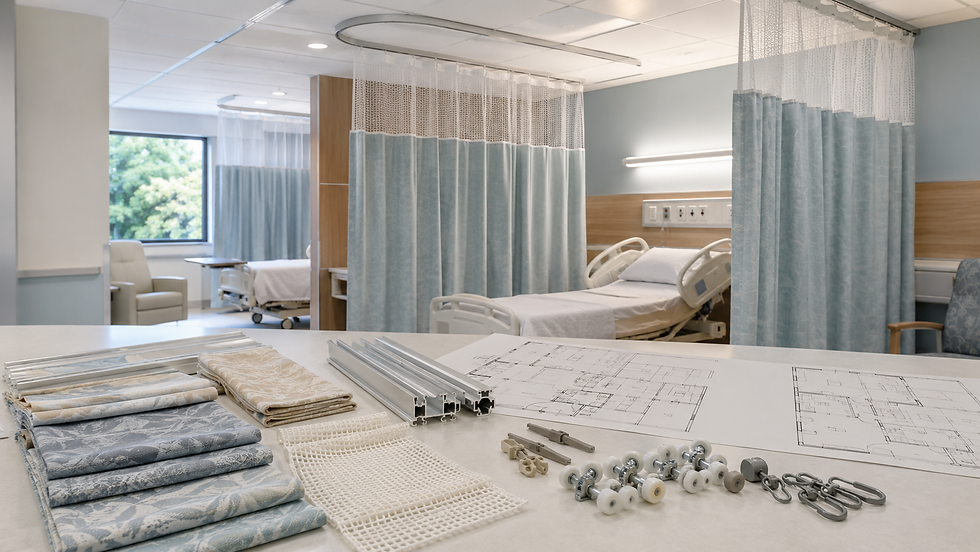
Ceiling-mounted tracks remain the most common choice in modern hospitals because they maximise floor space and allow curtains to surround patient beds completely. This improves patient privacy while making cleaning easier around beds, wheelchairs and medical equipment.
Surface-mounted systems are often used where building construction makes ceiling installation more difficult. They can provide an effective solution during refurbishment projects or in smaller treatment rooms where simple straight curtain layouts are sufficient.
The correct system depends on how the space functions rather than simply how it looks.
Choosing Tracks for Different Clinical Areas
Every department places different demands on a curtain system.
Emergency departments require tracks that can withstand continuous use throughout the day. Curtains must move easily and allow quick replacement without delaying patient care.
Medical and surgical wards typically prioritise durability and reliability. These departments need systems capable of handling years of daily operation with minimal maintenance.
Outpatient clinics may place greater emphasis on appearance and smooth operation, while intensive care units often require track systems that simplify rapid curtain replacement as part of infection prevention procedures.
Matching the track system to the department usually delivers better long-term performance than installing the same specification throughout an entire facility.
Material Quality Matters
Hospital curtain tracks operate thousands of times every year.
High-quality aluminium tracks generally offer excellent strength while remaining lightweight and corrosion resistant. Precision-manufactured rails also allow carriers to glide smoothly, reducing wear on both the track and the curtain.
Lower-quality systems may appear similar initially but often develop problems as carriers wear, joints loosen or track sections become misaligned.
Procurement teams should evaluate expected service life alongside the initial purchase cost.
Installation Should Be Planned Carefully
Installing hospital curtain tracks involves more than fixing rails to a ceiling.
Lighting, sprinkler systems, medical gas services, ventilation ducts and ceiling construction all influence the final layout. Careful planning ensures curtains can move freely without interfering with essential building services.
Future flexibility should also be considered. Departments evolve over time, and modular track systems make it easier to reconfigure patient bays without replacing the entire installation.
Good planning today often prevents expensive alterations later.
Maintenance Is Part of the Buying Decision
Every track system requires inspection, even the highest-quality products.
Facilities teams should routinely check for worn carriers, loose fixings, damaged joints and sections where curtain movement becomes restricted. Addressing these issues early helps prevent larger repairs and reduces disruption to patient areas.
Tracks designed with replaceable components also simplify maintenance. Individual carriers or fittings can often be replaced without removing the complete rail system, reducing labour and keeping clinical spaces operational.
Supporting Infection Prevention
Hospital curtain tracks also contribute to infection control.
Smooth-running systems allow curtains to be replaced quickly with less handling, helping environmental services teams complete routine curtain changes more efficiently.
Many healthcare facilities pair modern track systems with disposable privacy curtains to simplify replacement schedules and reduce contamination risks in high-turnover clinical areas.
More information is available at:
Questions to Ask Before Buying Hospital Curtain Tracks
Before selecting a track system, facilities managers should consider how it will perform over its entire service life.
Will it support the department's daily workload? Can replacement parts be obtained easily? Is the system suitable for future refurbishment projects? Will maintenance be straightforward without disrupting patient care?
Answering these questions early usually leads to better purchasing decisions than focusing on installation cost alone.
Further information about hospital curtain systems is available at:
Selecting the Right System for Long-Term Performance
Hospital curtain tracks should be viewed as long-term infrastructure rather than simple hardware.
A well-designed system supports patient privacy, improves staff workflow, simplifies maintenance and adapts as healthcare facilities evolve. By selecting tracks that suit both the building and the clinical environment, hospitals can reduce ongoing maintenance costs while creating more efficient patient care spaces.



Comments