

How Medical Curtain Rails Improve Clinical Workflow

Clinical workflow is shaped by hundreds of small actions. A nurse closes a curtain before an examination. A physician needs immediate access to a patient. Environmental services prepare a bay for its next occupant. Equipment moves between treatment spaces.
Medical curtain rails sit in the middle of many of these routine tasks.
A well-designed system attracts little attention because it works as expected. Curtains move easily, patient bays can be enclosed quickly, and staff can gain access without struggling with the hardware.
Poorly designed or deteriorating rails have the opposite effect. Curtains catch, carriers stick, gaps appear, and staff spend time dealing with equipment that should require almost no thought.
For a busy hospital, those small interruptions can occur hundreds of times each day.
Faster Privacy When Staff Need It
Patient privacy often needs to be established within seconds.
Emergency examinations, bedside procedures, personal care, and sensitive conversations can all require staff to close a privacy curtain quickly. Medical curtain rails should allow this to happen with a smooth, continuous movement.
Tracks that snag or require repeated pulling interrupt that process. A curtain may also remain partly open because a staff member cannot easily move it around a bend or through a poorly aligned track joint.
Reliable movement allows clinical staff to concentrate on the patient rather than the curtain system.
Better Access Around Patient Beds
Privacy and access need to work together.
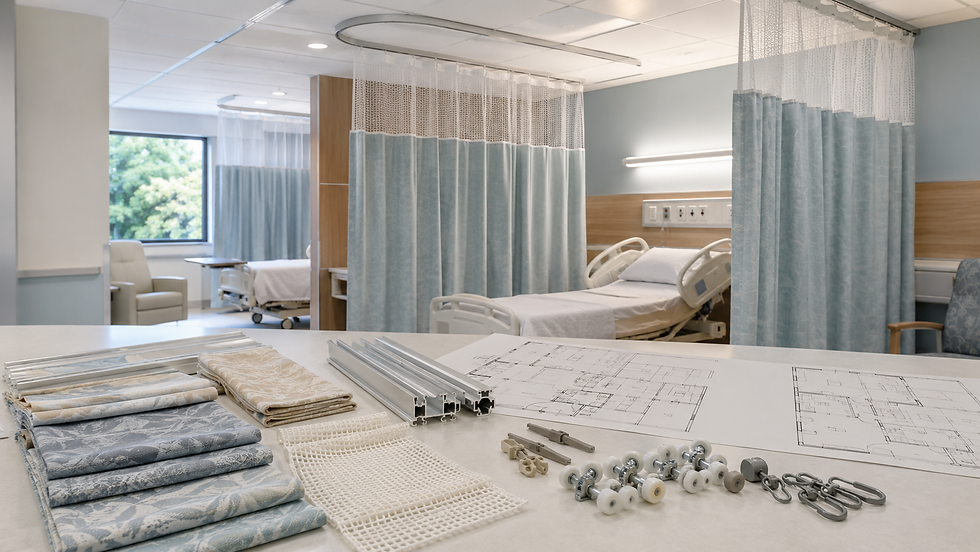
A curtain layout that encloses a bed effectively must also allow doctors, nurses, therapists, and other clinical staff to reach the patient when required. Ceiling-mounted medical curtain rails can be configured around individual bays while leaving the floor completely clear.
This matters when staff are moving wheelchairs, IV poles, mobile monitors, medication carts, and other equipment through restricted spaces.
Curved rails can also create privacy around the bed without requiring permanent partitions. Staff can open the entire area when greater access is needed and close it again once treatment is complete.
More information about healthcare curtain systems is available from Hospital Cubicle Curtains:https://www.hospitalcubiclecurtains.com/
Supporting High-Turnover Departments
Workflow becomes particularly important in emergency departments, recovery units, and other areas where patient turnover is high.
Treatment spaces need to move rapidly between occupied, cleaning, and ready-for-use status. A curtain system that is difficult to operate or maintain can add unnecessary friction to this process.
Medical curtain rails designed for frequent use should tolerate repeated opening and closing without carriers becoming difficult to move. The system should also allow curtains to be removed and replaced without taking a patient bay out of service for longer than necessary.
A few minutes may appear insignificant during an individual curtain change. Multiply that delay across numerous bays and repeated changes, and the operational effect becomes much more noticeable.
Curtain Changes Should Not Become Maintenance Projects
Privacy curtains need periodic replacement for infection prevention, damage, or routine maintenance. The rail design determines how straightforward that job becomes.
Quick-change systems can reduce the amount of handling and physical work required to remove curtains. Maintenance and environmental services teams can complete the task faster, helping return the treatment area to clinical use.
This is particularly useful where disposable curtains form part of the facility's infection prevention procedures.
Disposable curtain options can be viewed here:https://www.hospitalcubiclecurtains.com/disposable-cubicle-curtains
Track compatibility should be considered before changing curtain types. A new curtain may offer practical benefits, but those benefits can be reduced if the existing rail system makes replacement unnecessarily difficult.
Reliable Rails Reduce Avoidable Interruptions
A damaged carrier or misaligned section of track may seem like a minor facilities issue. In an occupied patient area, it can become considerably more disruptive.
Maintenance staff may need access above the bed. Clinical equipment could require repositioning. The patient might need to be moved temporarily, or the bay could become unavailable until repairs are completed.
Preventative inspection of medical curtain rails helps identify worn carriers, loose fittings, damaged joints, and movement problems before complete failure occurs.
High-use departments deserve particular attention because repeated curtain movement accelerates wear.
Flexible Rails Help Clinical Spaces Adapt
Hospital departments rarely remain unchanged throughout the life of a building.
Bed configurations change. Treatment areas are reorganized. New equipment arrives. Departments expand or alter how they use existing space.
Modular medical curtain rails can make these changes easier to accommodate. Depending on the system and building structure, tracks may be extended or reconfigured rather than completely replaced.
That flexibility can be particularly useful during refurbishment projects where facilities teams need to modify patient spaces without introducing permanent walls.
Planning for possible future changes at the specification stage can reduce disruption and unnecessary expenditure later.
Track Layout Needs to Reflect the Department
There is no single rail configuration that works best throughout an entire hospital.
An emergency department may prioritize rapid operation and heavy daily use. An intensive care environment needs excellent access around beds and equipment.
Outpatient treatment rooms may have simpler privacy requirements and lower curtain usage.
Facilities and procurement teams should examine how staff actually move through the space before finalizing the track layout.
Questions worth considering include how often the curtain will move, where staff normally approach the bed, which equipment regularly enters the bay, and how curtains will be changed.
Those practical details can reveal problems that are difficult to identify from architectural drawings alone.
Small Hardware Decisions Can Have a Large Operational Effect
Medical curtain rails are rarely the most expensive equipment within a patient care area, but their influence extends across privacy, maintenance, cleaning, staff movement, and room availability.
The strongest systems do not demand attention from clinical staff. They allow curtains to move smoothly, provide privacy when required, withstand frequent use, and make routine replacement straightforward.
For facilities managers and healthcare procurement teams, that makes rail specification a workflow decision as much as a hardware purchase.
Choosing medical curtain rails around the practical demands of each department can remove repeated sources of delay and help clinical spaces function as intended.



Comments