

Hospital Cubicle Curtain Accessories Every Facility Should Consider

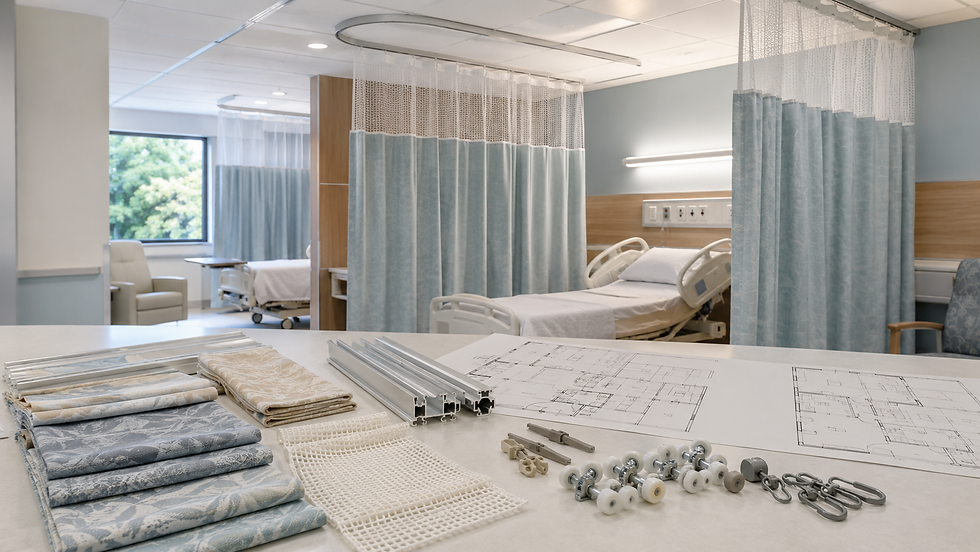
Hospital facilities should consider curtain carriers, hooks, end stops, track connectors, suspension hardware, and replacement components when specifying or maintaining a privacy curtain system. Accessory compatibility matters because even a small component can affect how reliably the complete system performs.
Why Curtain Accessories Deserve Attention
The curtain and track are the most obvious parts of a hospital privacy system. Between them sits a collection of much smaller components that staff may barely notice until something stops working.
A worn carrier can make a curtain difficult to move. A missing end stop can allow carriers to leave the track. Incorrect suspension hardware can create installation problems before the curtain is even fitted.
Cubicle curtain accessories therefore deserve consideration at the specification stage, not simply when maintenance teams need an emergency replacement.
For facilities managers and procurement teams, the objective is straightforward: create a complete system in which the individual components work together and can be maintained without unnecessary disruption.
Curtain Carriers Keep the System Moving
Carriers, sometimes referred to as glides or rollers depending on the system, connect the curtain to the track and allow it to move.
Their size makes them easy to underestimate. In a busy emergency department or inpatient unit, though, carriers may travel along the same track repeatedly throughout every shift.
Smooth movement matters. If one carrier begins dragging, staff often compensate by pulling the curtain harder. That additional force can transfer stress to other carriers, the curtain attachments, and the track itself.
Replacement carriers should match the installed track. Facilities with extensive curtain installations can also benefit from keeping compatible replacements available rather than waiting for a small component to fail before sourcing it.
Hooks and Curtain Attachments Need to Match the Application
The connection between the carrier and curtain needs to be dependable without making routine curtain changes unnecessarily complicated.
Hooks and other attachment components come in different configurations. The correct choice depends on the track and curtain system already in use.
This becomes particularly relevant when a facility changes from one curtain type to another. Assuming a new curtain will automatically work with existing hardware can lead to avoidable problems during installation.
For larger replacement projects, checking compatibility before ordering hundreds of curtains is considerably easier than discovering the problem once installation has started.
End Stops Perform a Small but Important Job
An end stop prevents carriers from unintentionally running out of an open track end.
It is a simple component, yet a missing or damaged stop can cause immediate inconvenience. Carriers can become detached, curtains may hang incorrectly, and maintenance staff may need to intervene in an occupied clinical area.
End stops should be checked during routine track inspections, particularly after curtain replacement or other work involving the track.
Where a system incorporates removable end stops to provide maintenance access, staff should make sure they are properly refitted once the work is complete.
Track Connectors Matter on Larger Installations
Not every patient privacy enclosure can be created from a single piece of track.
Larger configurations may require track sections to be joined together or combined with bends and other components. Connectors help create a continuous path for the curtain carriers.
Alignment is important. Even a small mismatch between sections can create a point where carriers catch each time the curtain passes.
That repeated resistance is frustrating for clinical staff and can accelerate wear.
When a curtain consistently sticks in exactly the same place, the joint or connector is one of the areas worth inspecting.
More information about hospital curtain and track solutions is available from Hospital Cubicle Curtains.
Suspension Hardware Helps Solve Different Ceiling Requirements
Hospital ceilings vary considerably.
A track may be fixed directly to an appropriate ceiling structure in one department while another installation requires suspension hardware to position the track at the correct height. The building structure and track manufacturer's requirements should determine the mounting arrangement.
Suspension components need to provide adequate support while maintaining the required track position around the patient area.
Planning becomes particularly important where lighting, HVAC equipment, sprinklers, medical services, or other ceiling-mounted systems occupy the same space.
A curtain track should fit into that environment without compromising the function or access requirements of surrounding building services.
Curves and Bends Create Practical Privacy Layouts
Straight tracks work well in some examination rooms, but patient bays frequently require curtains to travel around corners.
Curved track components allow facilities to create L-shaped, U-shaped, and other configurations around beds and treatment spaces. This provides visual privacy while leaving the floor beneath the system clear.
The quality of these components affects everyday operation. Carriers should pass through curves without excessive resistance or staff having to repeatedly tug the curtain.
Where a track system contains several bends, facilities teams should pay particular attention to these areas during routine maintenance.
Quick-Change Components Can Reduce Downtime
Curtain replacement can become a significant workload in a large healthcare facility.
Systems designed to simplify curtain removal and installation can reduce the time environmental services or maintenance personnel spend working in each bay. This is especially relevant where curtains are replaced frequently under facility infection prevention procedures.
The benefits become more noticeable at scale. Saving a small amount of time on one curtain change may seem insignificant. Across dozens or hundreds of patient spaces, the cumulative difference can be substantial.
Facilities using disposable curtains should consider the complete replacement process rather than assessing the curtain in isolation.
Information about disposable options is available from Disposable Cubicle Curtains.
Replacement Parts Should Be Considered Before They Are Needed
A hospital curtain track may remain in place through several generations of privacy curtains.
During that service life, carriers, hooks, stops, and other individual components can require replacement. Procurement teams should therefore consider parts availability when selecting a system.
A track that performs well but relies on difficult-to-source proprietary components can create problems years later.
Facilities managing large installations may benefit from identifying the components most likely to require routine replacement and maintaining a sensible inventory of compatible parts.
This can turn what might otherwise become an urgent purchasing request into a straightforward maintenance task.
Accessory Compatibility Protects the Complete System
Mixing components simply because they appear physically similar can be a false economy.
Carriers need to fit the track correctly. Hooks need to work with both the carrier and curtain. Connectors should maintain proper track alignment. Suspension hardware must suit the installation requirements.
Poor compatibility can produce resistance, premature wear, unstable fittings, or curtains that do not hang correctly.
For new installations, sourcing compatible components as part of a complete system removes much of this uncertainty. Existing installations should be identified accurately before replacement accessories are ordered.
Think Beyond the Curtain
Cubicle curtain accessories are inexpensive compared with much of the equipment used in a hospital, but their effect on the privacy system is disproportionate to their size.
The right carriers keep curtains moving. Secure end stops keep those carriers in place. Proper connectors create smooth transitions between track sections. Suitable suspension hardware supports the installation, while readily available replacement parts make maintenance easier.
Facilities managers specifying a new system should consider these components alongside the curtains and tracks themselves. For existing installations, maintaining a supply of commonly required cubicle curtain accessories can help resolve minor problems before they interfere with patient privacy or clinical workflow.



Comments