

Choosing Cubicle Curtains for Emergency Departments
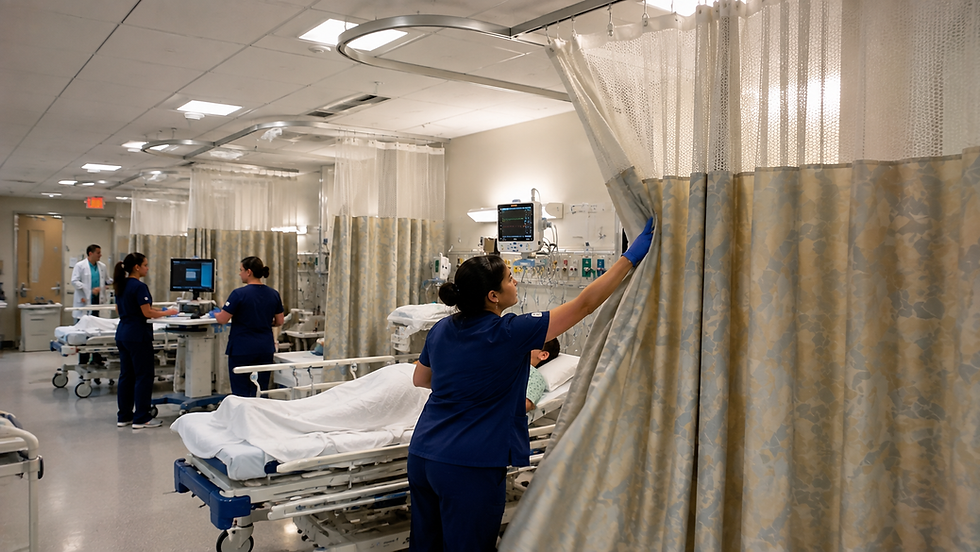
Emergency Departments Place Unique Demands on Curtain Systems
Few hospital environments are as demanding as an emergency department.
Patients arrive around the clock with a wide range of conditions. Beds are occupied continuously, staff move quickly between treatment bays, and privacy curtains are opened and closed hundreds of times every day.
Unlike many other hospital departments, emergency medicine operates at a pace where even small delays affect patient flow. A curtain that sticks, tears easily or takes too long to replace quickly becomes more than a maintenance issue. It becomes an operational problem.
Selecting the right emergency department curtains starts with understanding how these departments function.
Patient Privacy Cannot Be Compromised
Emergency departments are busy, noisy and often crowded. Patients may be assessed, examined or treated only a few feet away from others.
Hospital cubicle curtains provide an immediate visual barrier that helps preserve dignity during consultations, examinations and treatment. Although they cannot eliminate background noise, they create a defined clinical space where patients feel more comfortable discussing personal medical information.
High-opacity fabrics are generally preferred in emergency settings because they reduce visibility while maintaining a bright, welcoming clinical environment.
Durability Is Essential
Emergency department curtains experience far more daily movement than curtains in most outpatient or administrative areas.
Carriers move constantly along the track, staff pull curtains quickly between patients and equipment is frequently positioned close to the fabric.
Low-quality curtains may begin to show wear surprisingly quickly under these conditions.
Facilities managers should look for products specifically designed for healthcare environments with reinforced fixing points, durable materials and compatibility with heavy-duty track systems.
Replacing curtains too frequently increases maintenance costs and places unnecessary pressure on environmental services teams.
Infection Prevention Should Influence Every Decision
Emergency departments treat patients with a wide variety of infectious and non-infectious conditions.
Curtains are touched repeatedly by healthcare professionals, patients and visitors throughout the day, making them one of the most frequently handled surfaces within the department.
Disposable curtain systems have become increasingly popular because they simplify replacement procedures and reduce handling during routine infection prevention programmes.
Instead of removing curtains for laundering, staff can replace the entire curtain quickly, helping maintain high hygiene standards while reducing downtime.
More information about disposable systems is available here:
Fast Curtain Replacement Supports Patient Flow
Every emergency department aims to maximise patient throughput without compromising care.
Curtain systems that allow quick replacement reduce the time treatment bays remain unavailable. This becomes particularly valuable during periods of high demand when every patient space matters.
Quick-change carriers and well-designed curtain tracks allow maintenance or environmental services teams to complete replacements efficiently without disrupting surrounding clinical activity.
Over the course of a year, those time savings become significant.
Don't Overlook the Track System
The curtain receives most of the attention, but the track determines how smoothly the entire system operates.
Damaged carriers, worn joints or poorly aligned tracks create unnecessary frustration for clinical staff. Curtains that snag or fail to close properly reduce privacy and slow routine patient care.
Whenever curtains are being replaced, the track system should also be inspected for wear, damaged fittings and smooth operation.
Replacing curtains without assessing the tracks often leaves the underlying problem unresolved.
Further guidance is available at:
Maintenance Should Be Planned, Not Reactive
Emergency departments rarely have time for unexpected maintenance.
Routine inspections help identify damaged curtains, worn carriers and loose fittings before they affect patient care. Planned replacement schedules also make budgeting more predictable while reducing emergency repair work.
Facilities that treat curtain systems as part of their preventative maintenance programme generally experience fewer operational interruptions and lower long-term maintenance costs.
Choosing the Right Emergency Department Curtains
The best emergency department curtains combine durability, patient privacy and practical maintenance.
High-quality fabrics, dependable curtain tracks and efficient replacement procedures all contribute to smoother clinical workflows. Selecting products designed specifically for demanding healthcare environments helps reduce operational disruption while supporting infection prevention and patient satisfaction.
For emergency departments where every treatment bay is valuable, investing in the right curtain system delivers benefits long after installation.


Comments